

_500x500.jpg)
『Inline Cfm Flow Meter: Measuring Compressed Air Velocity and Volume inside Pneumatic Networks』Related information(v cone flow meter|rotary gas meter|gallon meter|gear meter|metal tube rotameter|glass tube rotameter|nutating disk meter|transit time ultrasonic flow meter|wedge flow meter|pd meters|hydraulic flow meter|ultrasonic water flow meter|water flow meter|air flow meter|magnetic water flow meter|oxygen flow meter|gas flow meter|argon flow meter|air velocity meter|gasoline flow meter|fuel flow meter|ultrasonic water meter|digital water meter|nitrogen flow meter|solid flow meter|Oxygen tank flow meter|digital water flow meter|diesel fuel flow meter|steam flow meter|02 flow meter|compressed air flow meter|oil flow meter|liquid flow meter)

Inline CFM Flow Meter: Measuring Compressed Air Velocity and Volume inside Pneumatic Networks
Quick Answer: An inline CFM flow meter gives a direct readout of compressed air velocity and volume inside a pipe. For most pneumatic networks, Silver Instruments recommends a thermal mass flow meter with 4-20 mA HART output for stable SCFM or Nm3/h data. Send us your pipe size, pressure in bar, temperature in °C, and the flow range you expect.
What Inline CFM Flow Meters Actually Measure
An inline CFM flow meter is installed directly in the compressed air line. It measures the flow passing through the pipe cross section. CFM means cubic feet per minute. Many plants in Australia, Southeast Asia, and the Middle East still think in CFM while equipment datasheets use Nm3/h or SCFM. That unit gap causes confusion.
Actual CFM changes with pressure and temperature. Standard CFM is corrected to reference conditions. A DN50 pipe at 7 bar and 20 °C may read 350 CFM actual. The same mass flow could be 2,450 SCFM after correction. Inline meters with built-in density compensation handle this conversion automatically. Basic pitot or orifice devices do not.
Compressed air is expensive. A small leak in a 10 bar network can waste thousands of dollars per year. Most engineers skip this part until an energy audit shows the cost. We have seen this on customer sites many times. A paint manufacturer in Southeast Asia found one leaking 25 mm branch line was losing 18 percent of total compressor output.
Thermal Mass vs Vortex for Compressed Air
Silver Instruments supplies two inline flow meter types for compressed air. Thermal mass flow meters are the first choice for 80 percent of pneumatic networks. They measure mass flow directly. No separate pressure and temperature compensation is needed. Vortex flow meters work well on larger lines and at higher temperatures.
Thermal inline meters suit DN15 to DN100 pipe sizes. Accuracy is typically plus or minus 1.5 percent of reading from 0.5 to 100 percent of range. The output can be 4-20 mA HART, RS485 Modbus, or pulse. PT100 sensors are included because gas temperature changes the thermal signal.
Vortex meters handle higher flows and can be used up to 200 °C on some models. They produce a frequency signal that is proportional to velocity. This works well on DN25 to DN200 compressed air headers. But vortex meters need minimum velocity to shed vortices. Low flow below 3 m/s may not register.
For wet or dirty compressed air, a thermal meter with a slight probe angle reduces condensation issues. Install a filter or dryer upstream where possible. Water droplets cause false velocity spikes on thermal sensors.
Installation Inside Pneumatic Networks
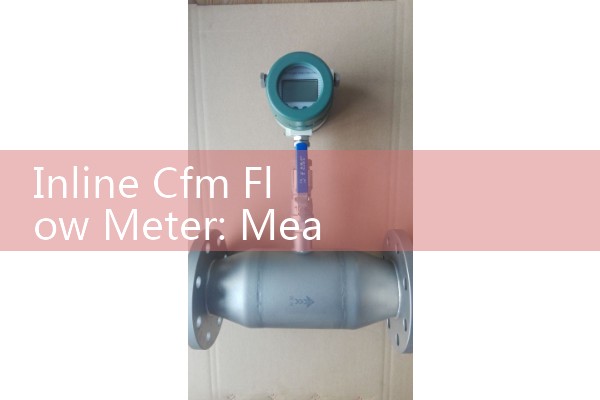
Inline mounting means the flow meter body becomes part of the pipe. For DN15 to DN50 lines, this is straightforward. Use compression fittings, flanges, or threaded connections. For DN80 and larger, wafer or flanged vortex meters are easier to install.
Straight run matters. A good starting point is 15D upstream and 5D downstream where D is pipe inner diameter. If the meter sits after a valve, elbow, or filter, add more upstream straight run. We recommend 20D upstream if the meter is close to a compressor aftercooler or a regulator.
Do not install the inline flow meter at the lowest point of the pipe. Condensate collects there. Do not install it right after a quick exhaust valve. Reverse flow and pulsation distort readings. In practice, a well placed meter on the main header after the dryer and filter gives the most stable data.
Outputs, Data Logging, and Leak Detection
Most compressed air projects need 4-20 mA HART because it connects directly to PLC and SCADA systems. Silver Instruments inline CFM flow meters also support RS485 Modbus RTU. S
Leak detection is easier with a totalizer. Run the compressor at night when production is off. If the totalizer keeps climbing, start isolating branch lines. A food packaging line in Indonesia used this method and found two leaks in less than one hour. The plant reduced compressor loading by 11 percent.
Data logging matters for energy audits. Feed the 4-20 mA signal to a paperless recorder or a PLC historian. Trending flow data against pressure and compressor amps shows system health. This is also how you justify a new dryer or a smaller compressor.
Recommended Silver Instruments Models for Compressed Air
For inline compressed air measurement in DN15 to DN100 lines, choose the Silver Instruments thermal mass flow meter with insertion or inline body style. It outputs 4-20 mA HART, RS485 Modbus, and has a local display. Accuracy is plus or minus 1.5 percent of reading. PT100 temperature compensation is built in.
For larger headers or high vibration areas, choose the vortex flow meter with temperature and pressure transmitter inputs. This works on DN25 to DN200 lines and handles up to 16 bar or higher on request. Use it where velocity stays above 3 m/s.
For hazardous area compressed air lines, ask for the ATEX Zone 1 certified version. These models carry the same 4-20 mA HART output and are available for DN15 to DN100 thermal meters.
If the pipe cannot be isolated, ask us about hot tap insertion thermal meters. These mount through a full port ball valve and allow online removal. A customer in the Philippines used this on a 100 mm cooling air line that could not be shut down.
FAQ: Inline CFM Flow Meter for Compressed Air
What is the difference between CFM and SCFM?
CFM is actual cubic feet per minute at line pressure and temperature. SCFM is corrected to standard conditions, usually 14.7 psia and 68 °F. The same air mass has different CFM values at 5 bar and 10 bar. A thermal mass flow meter can output SCFM directly.
Can an inline CFM flow meter measure air at 10 bar?
Yes. Standard inline thermal meters from Silver Instruments handle up to 16 bar. We need your operating pressure to confirm the flange rating and sensor limits. For higher pressure, PN40 or PN63 bodies are available.
What pipe sizes do Silver Instruments inline air flow meters cover?
We cover DN15 to DN200 with inline and insertion thermal models. Vortex meters cover DN25 to DN200. For rectangular ducts or pipes above DN200, we provide insertion probes with custom insertion length.
Do I need separate temperature and pressure compensation?
Not for a thermal mass flow meter. It measures the heat carried by the gas mass. The electronics convert this to standard volume flow. A vortex meter needs pressure and temperature inputs if you want SCFM or Nm3/h instead of actual velocity.
How do I request a quote for a compressed air flow meter?
Send us your pipe size (DN), operating pressure (bar), temperature (°C), flow range, and output signal. That is enough for model selection and price. Contact Silver Instruments by Tel: +86-25-68650347, Whatsapp: +86-25-52155837, or WeChat: +86 15365082610.
Request a Quote from Silver Instruments
Tell us your compressed air setup. We need the pipe size, pressure in bar, temperature in °C, and the expected minimum and maximum flow. Also state your required output: 4-20 mA HART, RS485 Modbus, pulse, or local display.
We serve industrial users and distributors in Australia, Southeast Asia, Latin America, Africa, and the Middle East. Send your parameters to Silver Instruments. Tel: +86-25-68650347. Whatsapp: +86-25-52155837. WeChat: +86 15365082610.
 Hot Product
 Related AD