

『Low Flow Meter With Pulse Output K-Factor Calculations』Related information(v cone flow meter|rotary gas meter|gallon meter|gear meter|metal tube rotameter|glass tube rotameter|nutating disk meter|transit time ultrasonic flow meter|wedge flow meter|pd meters|hydraulic flow meter|ultrasonic water flow meter|water flow meter|air flow meter|magnetic water flow meter|oxygen flow meter|gas flow meter|argon flow meter|air velocity meter|gasoline flow meter|fuel flow meter|ultrasonic water meter|digital water meter|nitrogen flow meter|solid flow meter|Oxygen tank flow meter|digital water flow meter|diesel fuel flow meter|steam flow meter|02 flow meter|compressed air flow meter|oil flow meter|liquid flow meter)
Low Flow Meter with Pulse Output: K-Factor Calculations and Field Tips
Quick Answer: A low flow meter with pulse output reports a K-factor in pulses per litre or pulses per gallon. You take this number and its measured frequency in Hz to calculate actual flow rate for your PLC or batch controller. A meter with K=2000 pulses/L outputting 33 Hz means an instantaneous flow close to 1 L/min.
What a K-Factor Means for Your Low Flow Meter
In pulse output flow meters, the K-factor is the number of pulses the electronics generate for a fixed volume of fluid passing the sensor. Manufacturers calibrate each meter individually and print the actual K-factor on the calibration certificate. You rarely use a generic number straight from a datasheet. Two meters of the same model can differ by several pulses per litre.
Low flow applications usually span 0.01 L/h to 500 L/h. At these rates, the K-factor must be high enough to produce a measurable frequency. If the K-factor is too low, your PLC input may miss pulses at very low flows. We always recommend a minimum of 100 pulses per litre at the lowest flow point you intend to measure.
Calculating Flow Rate and Pulse Frequency
The basic formula is: Flow Rate (volume per minute) = Pulse Frequency (Hz) x 60 divided by K-factor (pulses per litre). If your controller needs litres per hour, multiply that result by 60.
Here is a concrete example. An oval gear meter has a K-factor of 1830 pulses per litre. You observe a pulse frequency of 61 Hz on your frequency input module. The instantaneous flow in L/min equals 61 x 60 / 1830 = 2.0 L/min. That is 120 L/h. Most engineers let the PLC scaling block handle the math, but you still need the correct K-factor entered into the program.
For mass flow in kg/h, add one step: multiply the volumetric flow by the fluid density at operating temperature. Many Coriolis low flow meters output a mass pulse directly, with the K-factor given in pulses per kilogram. Silver Automation Instruments supplies Coriolis meters with pulse output for mass flows as low as 0.5 kg/h.
Matching the Meter Type to Your Low Flow Liquid
Not every pulse output meter works well at low flow rates. Vortex meters need a minimum Reynolds number and a stable velocity profile. Below a certain flow they stop forming vortices and the signal drops out. Electromagnetic meters can read down to very low flows, but the pulse resolution suffers if the converter design does not support low frequency capture. In practice, positive displacement meters like oval gear types handle low flows best, especially with viscous liquids above 5 cP.
We have seen this on customer sites many times. A chemical dosing skid with a vortex meter set for 2 L/h often ended up with zero output during winter because the fluid viscosity shifted and vortices did not form. After switching to an oval gear meter with a pulse output, the pulses became stable all year round.
Real Case: Dosing Fragrance in a Malaysian Beverage Plant
Last year, a fragrance supplier in Selangor, Malaysia, contacted us. They needed to inject less than 3 litres per hour of grapefruit essence into a mixing tank. The fluid behaved like a light oil, viscosity around 15 cP. Their old turbine meter had a K-factor of 500 pulses per litre. At 3 L/h, the pulse frequency was only 0.42 Hz. The PLC could
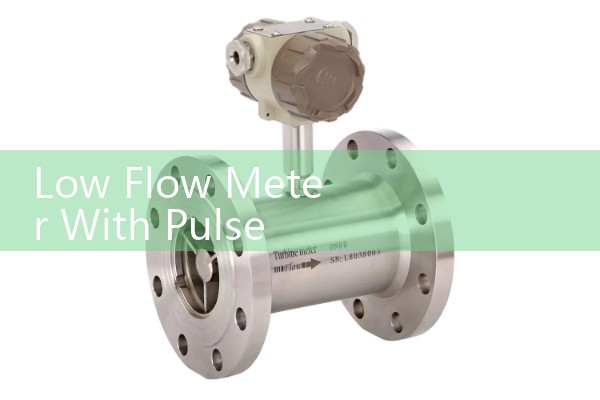
We recommended a Silver oval gear flow meter, model SGO-G02, with a standard K-factor of 2100 pulses per litre on that fluid. At 3 L/h, the frequency became 1.75 Hz, well inside the PLC capture window. The client calibrated the meter on site with a weight scale and stored the real K-factor of 2087 in the batch controller. Batch repeatability improved to within 1 gram on a 3 kg batch.
Silver Automation Instruments Low Flow Meters with Pulse
We keep a wide range of low flow meters with pulse output ready for quick shipment. Our oval gear meters cover DN4 to DN25 pipe sizes, with flow ranges from 0.5 L/h up to 1000 L/h. Standard K-factors range from 500 to 5000 pulses per litre depending on the size and gear geometry. Every meter leaves the factory with a 5-point calibration report stating the actual K-factor at that viscosity.
For clean water or conductive fluids above 20 uS/cm, our electromagnetic flow meters with battery powered pulse output work from DN6 upward. They let you configure the pulse weight, so you can set exactly 1 pulse per litre or 10 pulses per litre if your PLC needs a slower frequency.
When mass measurement matters, our micro Coriolis meters generate a mass pulse output directly in pulses per gram or pulses per kilogram, eliminating density compensation in the controller. These units are common in aroma, catalyst, and surfactant dosing in specialty chemicals plants across Thailand and Indonesia.
Get a Quote with Your Exact Operating Data
We do not use generic K-factors for sizing. Send us your fluid name, viscosity in cP, flow range in L/h or kg/h, pipe size in DN, and required output type (pulse, 4-20 mA HART, or RS485). Also mention if you need ATEX Zone 1 or FM approval for hazardous areas. Email these details to [email protected]. We reply within 24 hours with a model recommendation, lead time, and price.
Frequently Asked Questions
Can I change the K-factor in the field? You can adjust the scaling in the PLC or batch controller. The mechanical K-factor of the meter itself does not change unless internal gears wear down. Field calibration with a weight bucket is the best practice to verify the actual pulses per litre.
What is the minimum flow a pulse output meter can measure? This depends on the meter type. Oval gear meters can go down to 0.3 L/h in small sizes. At this rate you need a high K-factor above 2000 to get at least 0.17 Hz, which some PLCs can still capture with a 5-second update rate.
Do I need a separate power supply for the pulse output? Most pulse outputs are passive open collector or reed switch types. They need an external pull-up resistor and DC voltage from your PLC input module. We supply wiring diagrams with every meter.
Can the same meter output both 4-20 mA and pulse? Yes, many Silver meters offer dual outputs. You can use the 4-20 mA signal for a DCS and the pulse output for a local batch controller at the same time.
How often should I verify the K-factor? For clean liquids without solids, verify once a year. If the liquid has particles or the meter runs 24/7, check every 6 months. Any shift in K-factor usually indicates gear wear and it is time to replace the internals.
 Hot Product
 Related AD