

『Flow Meter for Large Pipes Selection: Clamp-On Ultrasonic vs Insertion Type Magmeters』Related information(v cone flow meter|rotary gas meter|gallon meter|gear meter|metal tube rotameter|glass tube rotameter|nutating disk meter|transit time ultrasonic flow meter|wedge flow meter|pd meters|hydraulic flow meter|ultrasonic water flow meter|water flow meter|air flow meter|magnetic water flow meter|oxygen flow meter|gas flow meter|argon flow meter|air velocity meter|gasoline flow meter|fuel flow meter|ultrasonic water meter|digital water meter|nitrogen flow meter|solid flow meter|Oxygen tank flow meter|digital water flow meter|diesel fuel flow meter|steam flow meter|02 flow meter|compressed air flow meter|oil flow meter|liquid flow meter)
Flow Meter for Large Pipes Selection: Clamp-On Ultrasonic vs Insertion Type Magmeters
Quick Answer: For large pipes from DN200 up to DN3000, clamp-on ultrasonic flow meters fit best when you cannot shut down the line or drill the pipe. Insertion type electromagnetic flow meters give better accuracy and lower cost for conductive liquids when a process connection is acceptable. Send your pipe size, fluid, pressure, temperature, and flow range to Silver Automation Instruments for a specific selection.
Why Large Pipe Flow Measurement Is Different
Large pipe flow is not the same as small line flow. A DN800 pipe can have a flow profile that changes a lot across the pipe diameter. Small inline meters assume a fairly stable profile. On a large pipe you need either multiple sensors or a measurement method that handles distorted profiles. Most engineers skip this part. Then the installation cost jumps because inline meters of DN400 and above become heavy, expensive, and hard to move without cranes.
In practice we see this on customer sites in Vietnam, Indonesia, and Saudi Arabia. A water treatment plant wants flow data on a DN700 header. They do not want to cut the pipe. They ask for a clamp-on solution first. If the water is conductive and the plant can accept a hot tap, an insertion magmeter becomes the lower cost option over 15 years.
Clamp-On Ultrasonic Flow Meters for Large Pipes
A clamp-on ultrasonic flow meter uses transducers mounted on the outside of the pipe wall. No wetted parts. No pressure loss. The measurement works on transit time difference. One transducer sends an ultrasonic signal through the liquid. The other receives it. Flow velocity changes the signal travel time. The transmitter converts that time difference into flow rate.
Typical pipe range is DN25 to DN3000. Accuracy is around 1.0 percent of reading for clean liquids on straight pipe runs. For DN800 and above, the accuracy can drop if the pipe has heavy scale or if the inner wall reflects signals poorly. Pipe material matters. Carbon steel, stainless steel, and PVC work well with proper couplant. Concrete pipe with a liner can be difficult. That is a common site issue in desalination plants with old cement lined pipes.
Here is the thing. Clamp-on ultrasonic is the easiest retrofit. It installs in hours without a shutdown. But the reading depends on clean sonic paths. Too many solids or gas bubbles weaken the signal. That rules out some raw sewage and high air entrainment applications. For those, an insertion magmeter is often better.
Insertion Type Magmeters for Large Pipes
An insertion type electromagnetic flow meter measures flow through a sensor inserted into the pipe. It uses Faraday law. The liquid must be conductive. Most water and wastewater is conductive enough at 20 µS/cm or higher. The sensor sits at a calculated insertion depth. That depth represents average flow velocity across the pipe. The transmitter converts velocity to volumetric flow rate based on the pipe inside diameter.
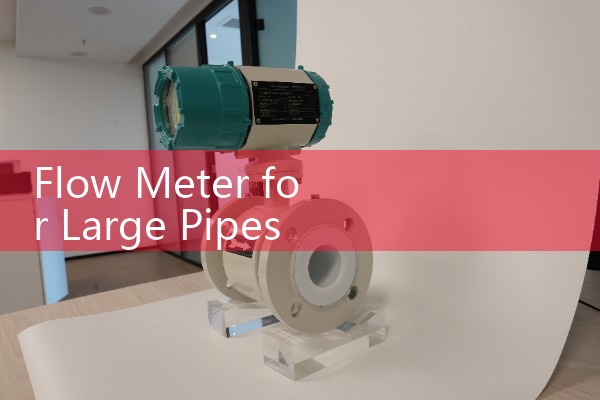
Pipe range is DN200 to DN3000 or larger. Accuracy is typically 0.5 percent of reading once the insertion depth is set correctly. Wetted parts can be 316L stainless steel, Hastelloy C, or titanium. Liners can be PTFE or PFA. Process connection may be a ball valve with hot tap capability. That means you can install the sensor under pressure without draining the line. Many plants in the Middle East choose this for large cooling water headers.
But there is a catch. You need to drill a hole in the pipe or use an existing fitting. That adds a mechanical step. You also need to input the pipe inside diameter and the sensor insertion depth. If those numbers are wrong, the flow reading shifts. We have seen this many times on DN600 pipes where the field team used the nominal diameter instead of the measured inside diameter.
Direct Comparison: Clamp-On Ultrasonic vs Insertion Magmeter
Clamp-on ultrasonic works on non conductive liquids if the sonic properties are known. Insertion magmeter does not work on oil, pure water, or gas. That is the first filter. Clamp-on has no wetted parts and no process connection. Insertion magmeter has w
Accuracy differs. Insertion magmeters typically reach 0.5 percent of reading. Clamp-on ultrasonic often achieves 1.0 percent of reading on straight runs. If you have a custody transfer or chemical dosing application, the insertion magmeter likely wins. So if you have a temporary measurement or a pipe that cannot be drilled, clamp-on wins.
Cost also differs. Clamp-on transmitters may cost more upfront for a portable or high accuracy model. Insertion magmeters often have lower installed cost on DN600 and above because the sensor is small and the transmitter is simple. But the clamp-on can move from one pipe to another. That flexibility matters for rental and audit work.
How to Choose Based on Pipe Size and Fluid
Start with the fluid. If it is non conductive, remove insertion magmeter from the list. If it is water, wastewater, seawater, acid, caustic, or slurry, both options may work. Then look at the pipe. If you cannot stop flow and cannot drill, use clamp-on ultrasonic. If you can accept a hot tap or a shutdown, compare installed cost and accuracy.
For DN200 to DN400, insertion magmeters are easy to install and very cost effective. For DN500 to DN1000, both options compete. For DN1200 to DN3000, clamp-on ultrasonic often wins when the pipe outside surface is accessible. For buried pipe, insertion magmeter may require less excavation because you only need a small access pit at the fitting.
Most engineers skip this part. They assume one technology fits all large pipes. That leads to poor readings on a DN900 wastewater line with sludge and air pockets. We have seen this in Southeast Asia. The right approach is to collect five data points and compare the two options on the same pipe.
Recommended Models from Silver Automation Instruments
Silver Automation Instruments supplies both types. The clamp-on ultrasonic model CL-152 covers DN25 to DN3000 with 4-20 mA HART, RS485 Modbus, and an optional data logger. Accuracy is 1.0 percent of reading. The transducer temperature range is -40 to 80 °C. Fluid temperature can be -40 to 160 °C depending on the transducer type.
The insertion type electromagnetic flow meter model IM-2500 covers DN200 to DN3000 with 0.5 percent of reading accuracy. Minimum liquid conductivity is 20 µS/cm. Process connections include 1-1/2 inch NPT, flange, and hot tap ball valve. Liner options are PTFE or PFA. Electrode options are 316L, Hastelloy C, and titanium. Output is 4-20 mA HART with RS485 Modbus. ATEX Zone 1 is available for hazardous areas.
Send us your pressure in bar, temperature in °C, pipe size in DN, and flow range in m3/h. Also tell us the pipe material and whether a shutdown is allowed.
Tel: +86-25-68650347. Whatsapp: +86-25-52155837. WeChat: +86 15365082610.
FAQ
Can clamp-on ultrasonic measure flow on a DN1000 pipe with cement lining?
Cement lining often blocks the ultrasonic signal. It can cause weak or unstable readings. Test the pipe or choose insertion magmeter if the lining is thick or rough.
What is the minimum conductivity for insertion type magmeter?
Most models from Silver Automation Instruments need 20 µS/cm. Some special designs work down to 5 µS/cm. For pure water or oil, use clamp-on ultrasonic or another technology.
Can I install an insertion magmeter without stopping flow?
Yes, if you use a hot tap ball valve assembly. The installer drills through the valve under pressure. This is common on water and cooling water lines up to 16 bar.
Which option is cheaper for DN600 water line?
In most cases insertion magmeter has a lower installed cost for DN600 conductive water. But if the pipe cannot be drilled or the line is temporary, clamp-on ultrasonic is cheaper overall.
Does Silver Automation Instruments provide field startup support?
Yes. We support remote setup through WhatsApp video or site visits in Southeast Asia, Oceania, the Middle East, Africa, and Latin America. Send your pipe data before ordering.
 Hot Blog
 Related AD