

_500x500.jpg)
『Peak Flow Meter vs Spirometer: Key Differences in Pulmonary Health Tracking』Related information(v cone flow meter|rotary gas meter|gallon meter|gear meter|metal tube rotameter|glass tube rotameter|nutating disk meter|transit time ultrasonic flow meter|wedge flow meter|pd meters|hydraulic flow meter|ultrasonic water flow meter|water flow meter|air flow meter|magnetic water flow meter|oxygen flow meter|gas flow meter|argon flow meter|air velocity meter|gasoline flow meter|fuel flow meter|ultrasonic water meter|digital water meter|nitrogen flow meter|solid flow meter|Oxygen tank flow meter|digital water flow meter|diesel fuel flow meter|steam flow meter|02 flow meter|compressed air flow meter|oil flow meter|liquid flow meter)
Peak Flow Meter vs Spirometer: Key Differences in Pulmonary Health Tracking
Quick Answer: A peak flow meter gives a single number for how fast a person can blow air out, mostly used to track asthma day to day. A spirometer records multiple lung volumes and flow rates for full diagnostic reports. For medical device manufacturers and calibration labs, both tools need traceable flow standards. Silver Automation Instruments supplies high-accuracy industrial gas flow meters that serve as those standards, directly supporting pulmonary device production and bench verification.
What a Peak Flow Meter Measures
A peak flow meter captures peak expiratory flow rate (PEFR), reported in liters per minute (L/min). The patient takes a deep breath and blows hard into a handheld plastic tube. The device has a spring-loaded piston or a simple vane that moves along a scale from 50 L/min to 800 L/min. Most engineers skip this part, but the internal mechanism is just a calibrated spring opposing airflow drag. In practice, a healthy adult male with no lung issues can hit 500 to 600 L/min. A child with asthma might read 150 L/min during a moderate attack. Doctors use personal best measurements and green-yellow-red zones to adjust medication. The meter does not record a flow curve or volume. It only captures that single peak value. Because the reading depends on patient effort, repeatability is around 5 to 10 percent. Still, for home use it works fine. We have seen customers in Southeast Asia source components for these plastic meters with tolerance of plus minus 10 percent full scale.
How a Spirometer Works
A spirometer is a diagnostic instrument that measures forced vital capacity (FVC), forced expiratory volume in one second (FEV1), slow vital capacity, and maximal voluntary ventilation. It produces a flow-volume loop and a volume-time curve. The sensing technology varies. Desktop spirometers often use a turbine, a pneumotachograph with a differential pressure sensor, or an ultrasonic transducer. Portable models use a pressure differential across a known mesh resistance. A turbine-based spirometer counts rotations under airflow. The electronics convert rotation pulses to flow in L/min and integrate flow over time to get volume in liters. Typical resolution is 0.01 L for volume and 0.01 L/s for flow. Accuracy for volume must meet ATS/ERS standards: plus minus 3 percent or 50 mL, whichever is larger. A 3-liter calibration syringe is used daily to verify accuracy. Last year a medical equipment startup in Indonesia ordered a Coriolis mass flow meter from us to replace an aging syringe standard. They needed a digital reference with 4-20 mA HART output to automate their calibration line. The Coriolis meter at DN15 size gave them plus minus 0.1 percent reading accuracy for air.
Key Differences in Design and Output
A peak flow meter is a simple mechanical device with a scale from 50 to 800 L/min, no electronics, and a price around AUD 15 to 40. A clinical spirometer costs AUD 800 to 4,000 and includes a microprocessor, display, and USB or Bluetooth for data export. The peak flow meter gives one parameter for home asthma care. The spirometer gives multiple parameters for diagnosing COPD, restrictive lung disease, and monitoring occupational lung health. In practice, a peak flow meter cannot detect small airway obstruction early because FEV1 and FVC are not reported. A spirometer can separate obstructive from restrictive patterns. Spirometry tests require a trained technician who coaches the patient to blow for at least 6 seconds. Peak flow testing needs minimal training but depends heavily on patient cooperation. Most general practitioners in rural clinics across Africa and Latin America start with a peak flow meter because of cost and simplicity. When they refer a patient to a pulmonologist, the specialist will run a full spirometry test with a volume-time curve and bronchodilator response.
Why Industrial Flow Meters Matter for Pulmonary Device Calibration
Both device types need calibration. A peak flow meter manufacturer verifies scale accuracy against a master flow meter. A spirometer maker uses a 3-liter syringe for volume checks and a calibrated flow generator for dynamic flow tests. Here is the thing: the syringe gives volume but not dy
Silver Automation Instruments Flow Solutions for Medical Device OEMs
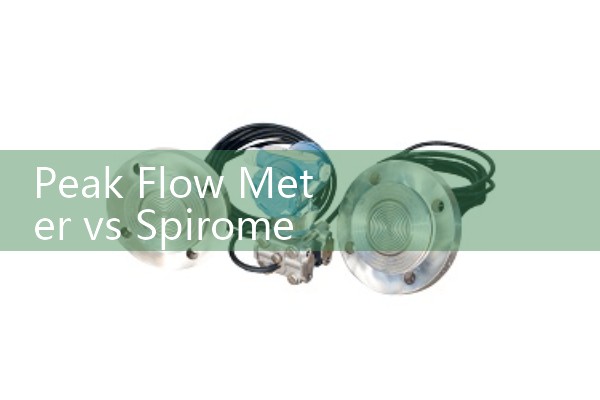
We do not sell peak flow meters or spirometers. We supply the industrial reference flow meters that their manufacturers and calibration labs trust. Our product range includes thermal mass flow meters for dry air and Coriolis mass flow meters for gas mixtures with changing density. A DN15 Coriolis meter from Silver Automation Instruments handles flow rates from 0 to 600 kg/h for air equivalent, with ATEX Zone 1 certification if needed. The wetted material is 316L stainless steel, suitable for medical-grade air with no contamination risk. For low-flow spirometer calibration, we recommend our thermal mass flow meter with a range of 0 to 50 L/min, response time under 1 second, and accuracy plus minus 1 percent full scale. The output options are 4-20 mA and RS485 Modbus. Many engineering teams integrate these meters into automated calibration stations that test 300 devices per shift. A client in Dubai uses three of our thermal mass flow meters set at 2 L/s, 8 L/s, and 12 L/s to check linearity of their turbine spirometer assemblies. They changed from manual syringe checks and saved 4 hours per batch.
FAQ
Can an industrial flow meter replace a calibration syringe for spirometers?
Yes, for dynamic flow linearity checks. A syringe gives a fixed 3-liter volume at one flow profile. An industrial mass flow meter can deliver known flow rates across the full range and verify response time. We recommend using both: syringe for volume zero and meter for multiple flow set points.
What flow meter accuracy is needed to calibrate a peak flow meter?
A peak flow meter marked at plus minus 10 percent of reading needs a reference at least plus minus 2 percent. Our thermal mass flow meters achieve plus minus 1 percent reading above 50 L/min, so they serve as a good standard. For the 800 L/min point, a Coriolis meter at DN15 works with plus minus 0.15 percent repeatability.
Which Silver Instruments meter handles the 0 to 800 L/min range?
Our DN15 Coriolis mass flow meter model covers 0 to 600 kg/h (roughly 0 to 800 L/min for air at standard conditions). The thermal mass flow meter model with a 0 to 1,000 L/min range is a more direct fit if the gas is clean dry air.
Do you supply meters with certificates for medical device calibration?
We supply a factory calibration certificate traceable to national standards. For pulmonary device makers needing ISO 13485 documentation, the calibration data can be provided in digital format. The certificates come with measurement uncertainty under 0.5 percent for Coriolis meters.
How do I get a quote for a flow meter for my spirometer test bench?
Send us your gas type (usually medical air), flow range in L/min, line pressure in bar, temperature in degrees Celsius, and required output signal to [email protected]. You can also reach us by phone at +86-135-1213-1526 or on WhatsApp at 86-135-12131526. Our engineering team will reply with a specific model and a price within one working day. WeChat inquiries are welcome at +86 13512131526.
 Hot Product
 Related AD