

『Flow Meter Types: Choose the Right Technology』Related information(v cone flow meter|rotary gas meter|gallon meter|gear meter|metal tube rotameter|glass tube rotameter|nutating disk meter|transit time ultrasonic flow meter|wedge flow meter|pd meters|hydraulic flow meter|ultrasonic water flow meter|water flow meter|air flow meter|magnetic water flow meter|oxygen flow meter|gas flow meter|argon flow meter|air velocity meter|gasoline flow meter|fuel flow meter|ultrasonic water meter|digital water meter|nitrogen flow meter|solid flow meter|Oxygen tank flow meter|digital water flow meter|diesel fuel flow meter|steam flow meter|02 flow meter|compressed air flow meter|oil flow meter|liquid flow meter)
Flow Meter Types: Choose the Right Technology
Quick Answer
Selecting the right flow meter depends on your fluid first, not on the catalog. For conductive water-based liquids, an electromagnetic flow meter is the safe bet because it has no moving parts and zero pressure drop. For viscous oils, heavy fuels, or adhesives, an oval gear meter gives repeatable volumetric measurement even at 2 L/h.
Share your fluid conductivity in µS/cm, viscosity in cP, pipe size in DN, and flow range in m³/h or kg/h. We at Silver Automation Instruments will reply with a specific model and a price within one day.
Write Down Five Numbers Before You Pick a Meter
Most engineers skip this part and start comparing technologies. Here is the thing. Five data points decide 90 percent of the selection. Fluid name and its phase. Liquid, gas, or slurry with up to 30 percent solids changes everything. Conductivity in µS/cm. This matters for magnetic flow meters. A minimum of 5 µS/cm is typical, but for demineralized water we need to look elsewhere. Viscosity in cP at operating temperature. A paint plant in Vietnam measured alkyd resin at 800 cP and 70 °C. An oval gear meter handled it easily. Flow range in kg/h or m³/h. Pipe size in DN and pressure in bar. Write these down and the technology choice becomes obvious.
Electromagnetic Flow Meters for Conductive Liquids
Use a magnetic flow meter when your fluid conducts electricity. Water, wastewater, acids, caustic soda, slurries, and fruit juice all work. Sizes from DN15 up to DN2000. A desalination plant in Saudi Arabia runs ten of our SIL-MAG meters on seawater intake lines with PTFE liners and Hastelloy C electrodes. No pressure drop, no moving parts, accuracy of ±0.5 percent of reading. Output signals are 4-20 mA HART, Modbus RS485, or pulse. In practice, if the fluid has at least 20 µS/cm, this is the most trouble-free meter we supply. But do not use it on diesel, vegetable oil, or any hydrocarbon. Conductivity is zero, and the meter will show no flow. We have seen this on customer sites many times. Always check conductivity first.
Coriolis Mass Flow Meters for Direct Mass Measurement
A Coriolis meter measures mass flow, density, and temperature all at once. No need for separate sensors. Our SIL-CMF series handles liquids and gases from 0.1 kg/h up to 700 t/h. Accuracy is ±0.1 percent of rate for mass flow and ±0.5 kg/m³ for density. A chemical distributor in Indonesia uses a DN25 Coriolis meter to dose solvents into reactors. The meter is mounted vertically to drain clean. Because it measures mass directly, changes in fluid density or temperature do not affect the reading. This meter also works for custody transfer of palm oil, methanol, or LPG. For high-viscosity fluids like glucose syrup at 5,000 cP, a straight-tube Coriolis meter avoids clogging. Standard outputs include 4-20 mA, pulse, and Modbus. Options for ATEX Zone 1 are available.
Oval Gear Flow Meters for Viscous Fluids and Small Lines
When you have a positive displacement application with high viscosity, the oval gear meter is tough to beat. Last year a biodiesel plant in Malaysia asked us to measure palm oil flow at 80 °C and 50 cP. We supplied a DN25 oval gear meter with PTFE gears and a pulse output. The meter runs 24 hours a day and needs no straight pipe runs. These meters handle diesel, heavy fuel oil, lubricants, bitumen additives, and even printing ink. Flow ranges start from 0.5 L/h on a DN4 meter. Accuracy is typically ±0.5 percent of reading. The rotating gears trap a known volume each turn. Every pulse represents a precise volume, such as 10 mL per pulse. This makes batch dosing simple. For fuels and oils with suspended solids, we add internal filters. Maintenance is low; many units in the field have been running for five years with only annual cleaning.
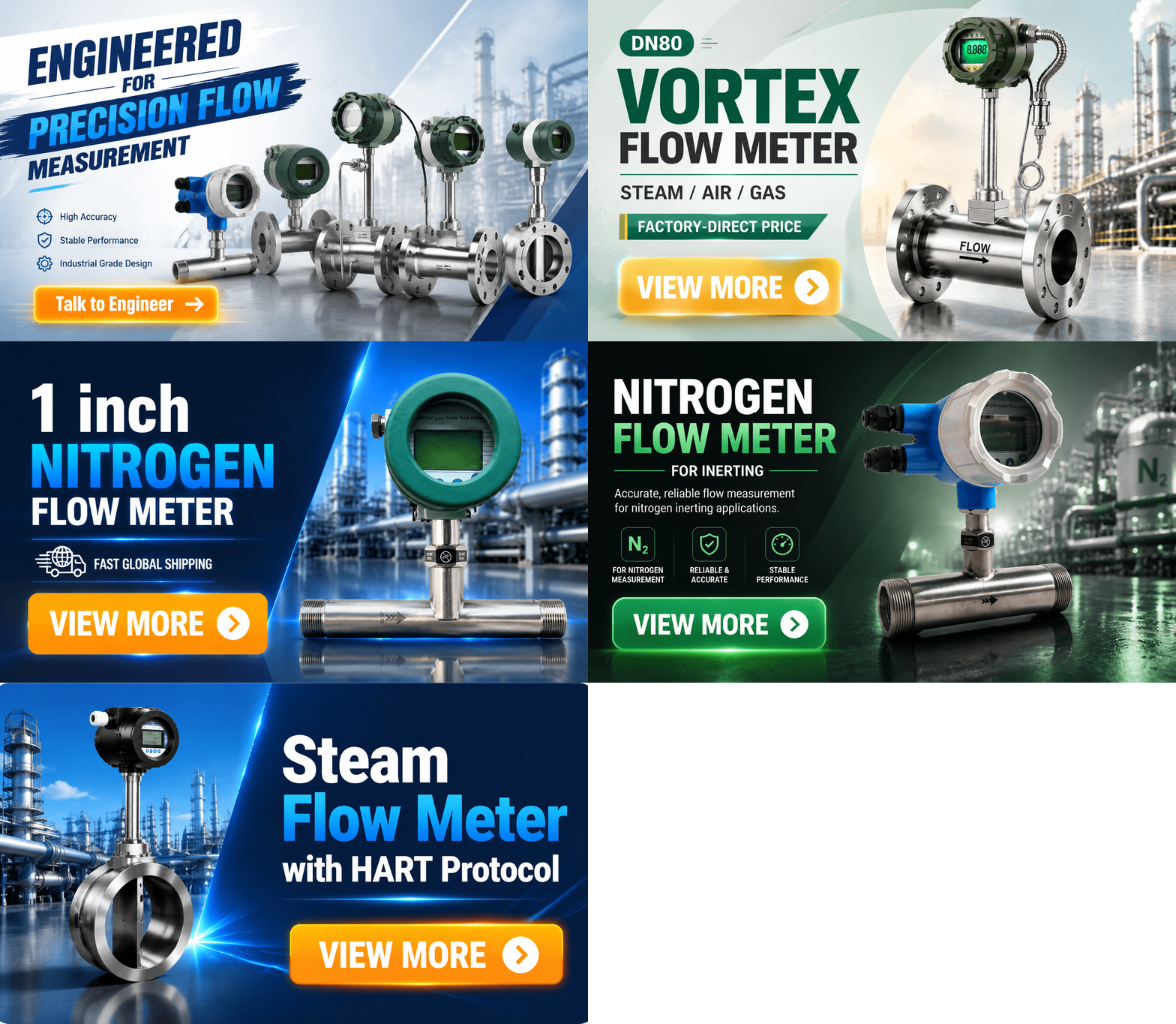
Vortex Flow Meters for Steam, Gas, and Clean Liquids
A vortex meter counts the vortic
_600x400.jpg)
Ultrasonic Flow Meters for Large Pipes and Non-Invasive Setup
Clamp-on ultrasonic flow meters measure flow from outside the pipe. This is a big advantage on large water mains, chilled water loops, or lines that cannot be shut down. A facility manager in Australia used a pair of SIL-US clamp-on sensors on a DN400 cement-lined pipe to verify pump efficiency. Installation took one hour without cutting the pipe. Accuracy is typically ±1 percent of reading with proper setup. Transit-time models need clean liquids with few bubbles or solids. For dirty water, a Doppler ultrasonic meter is available. Permanent inline spool-piece ultrasonic meters with 4-20 mA and Modbus are also an option for DN50 to DN300. They work well in district heating and cooling networks. Signal quality depends on pipe material and wall thickness. Our team can help assess your pipe before you order.
Thermal Mass Flow Meters for Dry Gas and Air
If you measure compressed air, nitrogen, oxygen, or natural gas at low flows, a thermal mass meter gives direct mass reading without pressure and temperature compensation. An automotive parts plant in South Africa monitors air consumption to 12 assembly stations using six SIL-TMF insertion probes. Each probe sends a 4-20 mA signal to a central control system. The insertion style meter fits pipes from DN80 up to DN600. Accuracy is ±1.5 percent of rate with a turndown of 100:1. This means one meter can read from 0.5 Nm³/h to 50 Nm³/h with no loss in accuracy. For line sizes below DN50, inline thermal mass meters with threaded connections are available. Keep the gas dry. Moisture and oil mist coat the sensor and cause drift. We include a sintered filter in the probe to protect the sensing elements.
Frequently Asked Questions
Can I use an electromagnetic flow meter for diesel?
No. Diesel has almost zero conductivity. The magnetic meter will not detect any flow. Use an oval gear or Coriolis meter for diesel and similar hydrocarbons.
What is the minimum straight pipe run for a vortex meter?
Plan for 15 pipe diameters upstream and 5 diameters downstream. In tight spaces, a flow straightener can reduce the requirement to 10D upstream.
Does Silver Automation Instruments supply flow meters for seawater?
Yes. Our electromagnetic meters with PTFE liner and Hastelloy electrodes work in seawater for desalination, ballast water, and cooling water lines. We also offer ultrasonic clamp-on meters for large seawater pipes.
Which meter measures both mass flow and density?
A Coriolis mass flow meter. It delivers mass flow, density, and temperature output simultaneously. Many customers in chemical and food industries use this single device instead of three separate instruments.
How do I get a price for a flow meter?
Send us your fluid name, viscosity in cP, conductivity in µS/cm, pipe size in DN, pressure in bar, temperature in °C, and flow range in kg/h or m³/h. We will return a specific SIL model with a datasheet and price quote.
 Hot Product
 Related AD