

 Current position > Product detail
『Chiller Flow Meter: HVAC Hydronic Loop BTU Balancing Sourcing Guidelines』Related information(v cone flow meter|rotary gas meter|gallon meter|gear meter|metal tube rotameter|glass tube rotameter|nutating disk meter|transit time ultrasonic flow meter|wedge flow meter|pd meters|hydraulic flow meter|ultrasonic water flow meter|water flow meter|air flow meter|magnetic water flow meter|oxygen flow meter|gas flow meter|argon flow meter|air velocity meter|gasoline flow meter|fuel flow meter|ultrasonic water meter|digital water meter|nitrogen flow meter|solid flow meter|Oxygen tank flow meter|digital water flow meter|diesel fuel flow meter|steam flow meter|02 flow meter|compressed air flow meter|oil flow meter|liquid flow meter)
Chiller Flow Meter Sourcing Guide for HVAC Hydronic Loop BTU Balancing
Quick Answer: For hydronic loop BTU balancing, choose an inline electromagnetic flow meter if the chilled or condenser water has conductivity above 20 µS/cm and the pipe is full. For retrofit jobs where shutdown is not possible, use a clamp-on ultrasonic flow meter on clean steel or copper pipe. Send us your pressure in bar, temperature in deg C, pipe size in DN, and flow range to get a matched BTU meter package.
Why the Flow Meter Determines BTU Accuracy
Chiller plant efficiency depends on two measurements: flow rate and temperature difference. Flow error hits the BTU total harder than a small RTD error. In practice, a 2 percent flow meter error plus a 0.1 deg C loop dT error can shift kW/ton data enough to hide fouling. That is why we see HVAC contractors move from handheld meters to fixed BTU meters on chiller lines.
Most engineers skip this part. They buy a chiller flow meter based on line size only. Then they install it too close to a pump elbow or control valve. The reading becomes noisy. The BAS trend logs look wrong. Sizing matters, but straight run and full pipe matter just as much.
Inline Electromagnetic Flow Meter for Chilled and Condenser Water
An inline electromagnetic flow meter works well on clean water with conductivity above 20 µS/cm. It has no moving parts. It handles pipe sizes from DN15 to DN300 and larger. The output can be 4-20 mA HART, pulse, or Modbus RTU. For hydronic loops where glycol content stays below 40 percent, mag meters are the standard pick.
We recommend an inline mag meter for new chiller plant builds and pump skids. You can install it between flanges with PTFE or EPDM liners. The display shows flow rate in m3/h or gpm. Add two matched RTDs or a paired temperature transmitter and the totalizer gives BTU or kW directly.
Do not install a mag meter on empty pipes or near air release pockets. Air slugs cause zero drift. If the pipe is not always full, use an insertion probe or an ultrasonic option.
Clamp-On Ultrasonic Flow Meter for Retrofit BTU Balancing
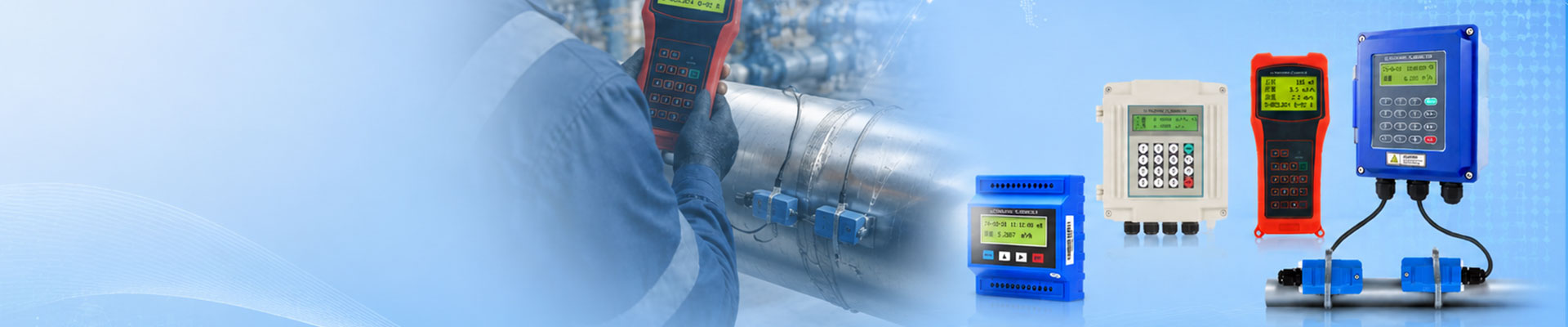
A clamp-on ultrasonic flow meter saves time on existing chilled water lines. You strap the transducers on the outside of the pipe. No pipe cutting, no drain down, no flange welding. This matters a lot in hospitals, data centers, and semiconductor plants where shutdown windows are short.
For hydronic loop balancing, clamp-on meters work best on clean liquid with low solids. Signal quality drops on old cast iron pipe with heavy scale. In that case, test the pipe signal before you commit. We have seen this on customer sites many times. A paint manufacturer in Southeast Asia ordered clamp-on meters for a chilled water retrofit. Two of eight lines had thin carbon steel pipe from the 1990s. The signal was weak until the installers cleaned the mounting spots down to bare metal.
Last year a customer in Vietnam asked us to size a DN150 clamp-on ultrasonic meter for a hotel chiller plant. The return line was copper with light insulation. We asked for wall thickness and glycol concentration first. Without that data the quote would have missed the correct sound speed setting.
Clamp-on ultrasonic flow meters also work on condenser water and low pressure chilled water risers. They are not ideal for glycol mixes above 50 percent because the sound speed changes with concentration. If you run a 30 percent glycol loop, tell us the concentration when you request a quote.
BTU Calculation and Temperature Pairing
BTU totalizer accuracy needs matched temperature sensors. You need two PT100 or PT1000 RTDs. One goes on the supply. One goes on the return. The flow meter calculates energy using mass flow, specific heat, and delta T. In chilled water systems the typical dT is 5 to 8 deg C. In condenser water the dT is often 3 to 6 deg C. The flow meter should handle both ranges.
Most BAS integration issues come from wiring and scaling. The flow meter sends a 4-20 mA signal to the BTU panel. If the 4 mA value is not zero flow and the 20 mA value does not match the meter max range, the totalizer reads twice the real BTU or half the re

Sourcing Checklist for Chiller Flow Meters
Here is a short list of parameters we ask from HVAC contractors and chiller plant operators before quoting:
Pipe size in DN. Line material, such as carbon steel, stainless steel, copper, or PVC. Liquid type, such as chilled water, condenser water, or glycol mix. Flow range in m3/h or gpm. Pressure in bar. Temperature in deg C. Signal output, such as 4-20 mA HART, pulse, or Modbus RTU. Power supply, either 24 VDC or 85 to 265 VAC.
This list avoids back and forth. A chiller flow meter quote without these details often misses the liner material or the flange rating. That causes delays at site.
Common Installation Mistakes on Hydronic Loops
Straight run is the biggest problem. Inline mag meters need 5D upstream and 2D downstream from a valve or elbow. Clamp-on meters need 10D upstream after a pump discharge. D means the internal pipe diameter. A DN100 meter after a pump with only 3D straight run will show unstable readings at partial load.
Air elimination comes second. Install air vents upstream of the flow meter. If the chiller loop pulls in air during startup, the meter will read flow spikes. The BTU totalizer then records phantom load. Use a flow switch or pressure differential check before enabling the BTU total.
Grounding comes third. For plastic pipes or lined pipes, use grounding rings or grounding electrodes. Electromagnetic flow meters on PVC chilled water lines without grounding rings produce a wandering signal. It looks like flow noise. It is not a meter fault. It is an installation omission.
Why Buy From Silver Instruments
Silver Automation Instruments supplies chiller flow meters from our factory to HVAC contractors and chiller plant operators in Southeast Asia, Oceania, Latin America, Africa, and the Middle East. We keep inline electromagnetic and clamp-on ultrasonic flow meters in standard ranges. We also wire matched PT100 RTDs into the same terminal box for BTU duty.
We ship with English manuals, 5 point calibration reports, and a wiring diagram specific to your BAS input card. Our support team checks your pipe size, flow range, and temperature delta before shipping. That prevents the wrong full scale range from leaving the factory.
Contact Silver Instruments for a chiller flow meter quote. Send us your pressure in bar, temperature in deg C, pipe size in DN, and flow range. Tel: +86-135-1213-1526. Whatsapp: 86-135-12131526. WeChat: +86 13512131526.
FAQ for Chiller Flow Meter and BTU Balancing
Question 1. Can one flow meter handle both chilled water and condenser water? Yes. An inline electromagnetic flow meter with EPDM or PTFE liner works for chilled water at 4 to 12 deg C and condenser water at 25 to 40 deg C. Check the pressure rating for the condenser side because it usually runs higher than the chilled water side.
Question 2. What is the minimum conductivity for a mag meter on a hydronic loop? The water or glycol mix should stay above 20 µS/cm. Clean city water is normally above 150 µS/cm. Demineralized water or pure water loops may need a special mag meter or an ultrasonic meter.
Question 3. How do you measure BTU with a chiller flow meter? You combine flow rate from the meter with supply and return temperature from matched RTDs. The flow meter or a separate totalizer computes energy from mass flow, fluid density, specific heat, and delta T.
Question 4. Can a clamp-on ultrasonic flow meter work on old chilled water pipe? Often yes if the pipe wall transmits signal well. Heavy internal scale, thick ductile iron, or loose pipe wrap can block the signal. We ask for pipe material, wall thickness, and whether the pipe is full before recommending a clamp-on meter.
Question 5. What output is best for HVAC BAS integration? 4-20 mA HART is the easiest for most chiller plant controllers. Modbus RTU gives you flow total, error codes, and temperature readings on one bus. Pulse output suits energy totalizers that need a direct volume input.